Workflows to create entities
Published on April 9th, 2026Overview
Workflows (entity-creation pipelines) are directed graphs that describe how data becomes Backstage catalog entities .
At the moment, these are constructed wholly in the Roadie Editor UI.
In the Editor you connect nodes on a canvas; execution moves from a trigger through sources and transforms into sinks. New workflows are created as entity-creation type so the graph is validated for publishing entities into the catalog.
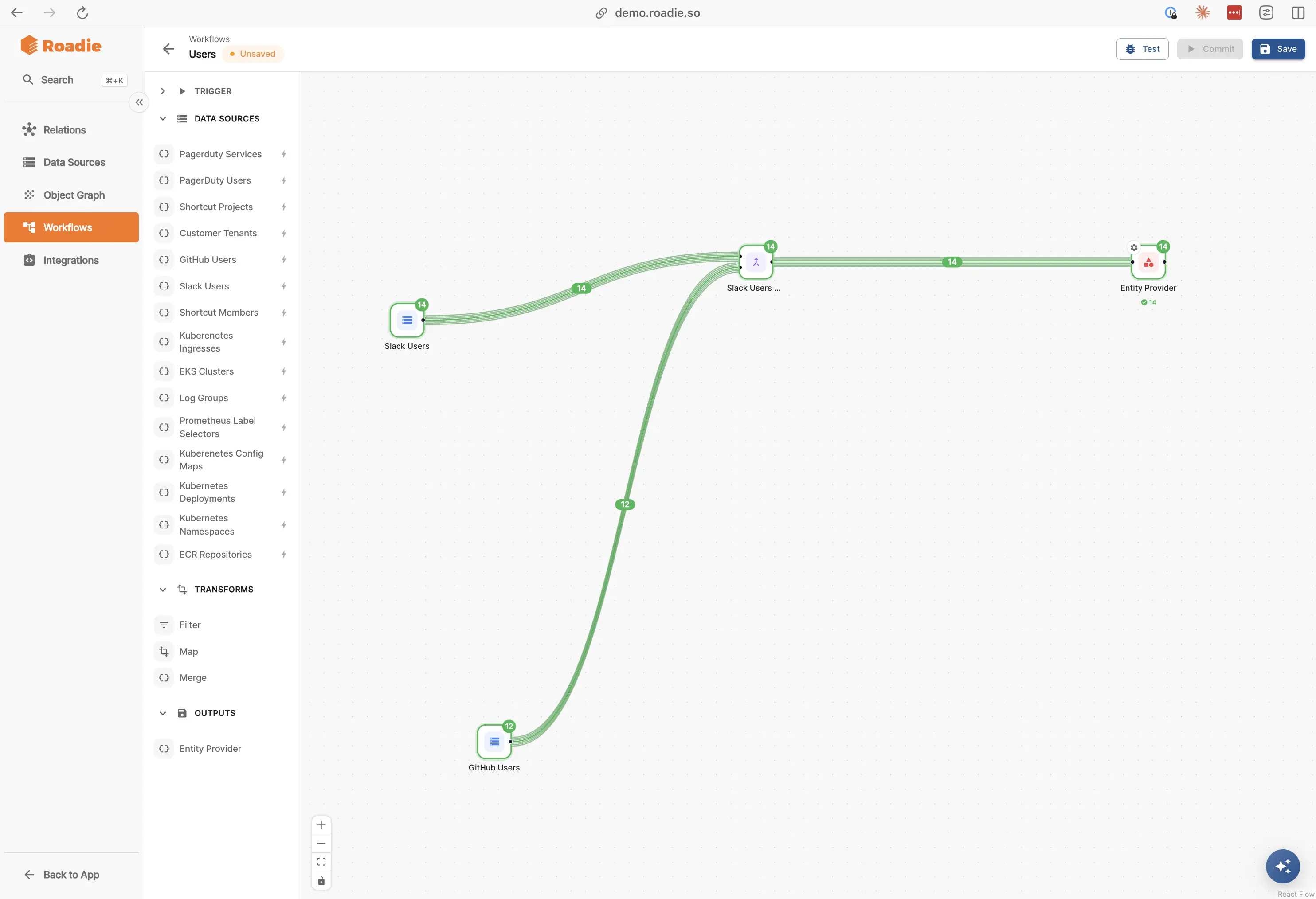
Triggers
| Node | Role |
|---|---|
| Schedule | Runs the workflow on a recurring interval (minutes, hours, days, or weeks; weekly schedules can optionally fix a day of week). |
Sources
| Node | Role |
|---|---|
| Data source | Reads objects from the catalog datastore, typically populated by data sources. |
Transforms
| Node | Role |
|---|---|
| Map | Transforms each item with a JSONata expression to shape fields for entity templates. |
| Filter | Keeps or drops items using JSONata. |
| Merge | Joins two inputs on configurable keys (for example correlating two datastore snapshots). |
Sinks
| Node | Role |
|---|---|
| Entity provider | Emits catalog entities via the entity provider mechanism, using templates (including Nunjucks) so each record becomes a valid entity. Standard kinds include Component, API, Resource, Group, User, System, Domain, Location, Repository, and Product, subject to your validators. |
Dry runs and operations
Where supported, nodes allow dry runs so you can validate extraction and transforms before enabling a schedule or relying on the workflow in production. Enable the workflow when you are satisfied, then monitor executions and adjust JSONata or templates when upstream APIs change.
Permissions
Workflow actions are protected by catalog workflow permissions (read, create, update, delete, and execute). Grant execute only to users or roles that should be able to run pipelines against real data.
