
Roadie vs. Port
Last updated on January 22nd, 2026Organizations are choosing Roadie over Port because they want the speed of a managed platform without the risks of a proprietary data model. Roadie combines the industry-standard power of Backstage with enterprise-grade security and maintenance—giving you a developer portal that you truly own.
Why Roadie?
Roadie eliminates the operational overhead of maintaining an Internal Developer Portal (IDP) while preserving the flexibility that only open-source software can provide. While Port locks you into a closed-source ecosystem, Roadie is built on Spotify’s Backstage. This ensures you benefit from a massive global community, limitless customization, and the freedom to take your data and platform logic in-house if your needs ever change.
Avoid Vendor Lock-in with an Open Standard
The most critical difference between Roadie and Port is the foundation. Port is a proprietary, closed-source SaaS product. Adopting Port means molding your engineering organization around their specific, proprietary data model. If the vendor raises prices, pivots direction, or ceases operations, you are locked in with no easy exit path.
Roadie is built on Backstage, the open-source standard. We manage the infrastructure, but the core technology is universal.
- Total Portability: You are never trapped. If you decide to self-host in the future, you can export your data and configuration to a standard Backstage instance.
- Future-Proofing: You are betting on a framework trusted by Spotify, Pinterest, and thousands of others—not the survival of a single early-stage startup.
Unmatched Integration Ecosystem
A developer portal is only useful if it connects to all your tools. If an engineer logs in and finds that 90% of their tools are there but a critical 10% are missing, trust in the platform erodes.
- Port is limited to the integrations their internal team builds or generic webhook adaptations.
- Roadie taps into the massive Backstage open-source ecosystem.
With access to hundreds of community-built plugins, you are far more likely to find support for niche tools, legacy systems, and cutting-edge utilities. You aren't waiting on a vendor’s roadmap to get the connectivity you need today.
Limitless Customization with Code
Port offers a "no-code" approach to UI, which is excellent for speed but hits a hard ceiling. You are restricted to the widgets, dashboards, and layouts the vendor permits.
Roadie provides the best of both worlds: no-code configuration for speed, and full-code customization when you need it. Because Roadie allows you to run custom Backstage plugins, you can write bespoke React and TypeScript frontends to visualize data exactly how your teams need to see it. You can build completely unique experiences that a proprietary widget builder simply cannot support.
Backed by a Thriving Global Community
When you choose Port, your support network is limited to their customer success team. When you choose Roadie, you are backed by a movement.
Roadie benefits from the collective intelligence of the Backstage community:
- Thousands of Contributors: Engineers from the world's top tech companies are constantly building new features and security patches for the core framework.
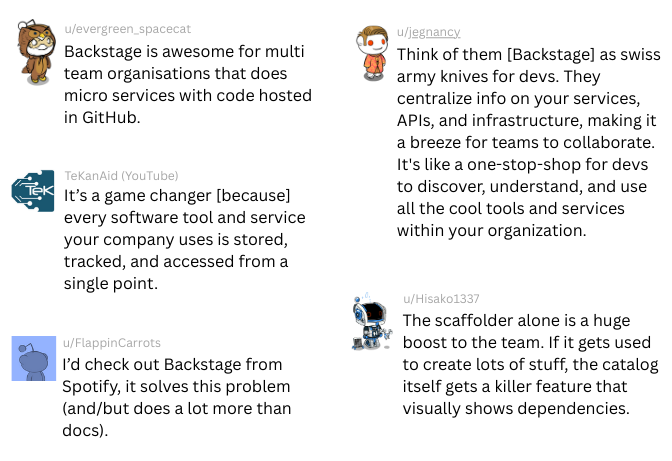
- Global Knowledge Base: With thousands of adopters including Pinterest, HP, and Roku, finding solutions, documentation, and best practices is easier than with a niche proprietary tool.
- Active Support: Beyond Roadie’s own 24/7 enterprise support, the massive Backstage Discord community ensures you are never developing in isolation.
Superior "Docs-as-Code" Experience
Documentation is often the first pillar of a successful IDP. Port renders Markdown files, but it lacks the specialized engineering focus of the Backstage TechDocs engine used by Roadie.
TechDocs treats documentation exactly like code. It includes a full build pipeline that generates static sites from Markdown files in your repositories, allowing for advanced search, validation, and a standardized reading experience that engineers love. It is a purpose-built documentation solution, not just a file viewer.
Feature Comparison
Roadie vs. Port: Open Flexibility vs. Closed Proprietary
| Feature | Roadie (Backstage) | Port |
|---|---|---|
| Foundation | ||
| Core Architecture | Open Source (Backstage) | Proprietary / Closed |
| Vendor Lock-in | Low (Can migrate to self-hosted) | High (Proprietary model) |
| Community Ecosystem | 1,000+ contributors | Vendor only |
| Customization | ||
| Custom UI Development | Unlimited (React/TypeScript) | Limited (Widget Builder) |
| Bring Your Own Plugins | ✅ | ❌ |
| Custom Data Model | ✅ | ✅ |
| Integrations | ||
| Plugin Ecosystem | Massive Community Library | Vendor Library only |
| Niche Tool Support | High | Low |
| Documentation | ||
| Engine | TechDocs (Full build pipeline) | Markdown Rendering |
| Docs-like-Code Best Practices | Native | Partial |
| Self-Service & AI | ||
| Scaffolder Templates | ✅ | ✅ |
| AI Search (RAG) | ✅ | ✅ |
| MCP Servers | ✅ | ✅ |
| Management | ||
| Fully Managed SaaS | ✅ | ✅ |
| Setup Time | Hours | Hours |
Frequently Asked Questions
What is the main risk of using Port over Roadie? The main risk is vendor lock-in. Port is a proprietary tool with a proprietary data model. If the company fails, gets acquired, or changes its pricing model, you cannot easily move your data or logic elsewhere. Roadie is built on open-source Backstage; if you ever leave Roadie, you can take your portal in-house.
Can I write custom UI code for Port? No. Port relies on a low-code "widget" approach. You can configure dashboards based on their pre-built blocks, but you cannot write custom React or TypeScript code to build entirely new functionality. Roadie allows you to upload custom plugins, giving you pixel-perfect control over the developer experience.
Why does the community matter for an IDP? Internal Developer Portals require integrations with dozens of tools. A proprietary vendor like Port cannot build integrations for every tool in existence. Roadie leverages the Backstage community, where thousands of developers at other companies are building and maintaining plugins. If you use a tool, chances are someone in the Backstage community has already built a plugin for it.
Is Roadie’s documentation feature better than Port's? Yes. Roadie uses TechDocs, a specialized "docs-like-code" solution that compiles Markdown into full documentation websites with search, navigation, and validation. It is designed specifically for engineering workflows, whereas Port’s documentation support is primarily a simple Markdown viewer.
